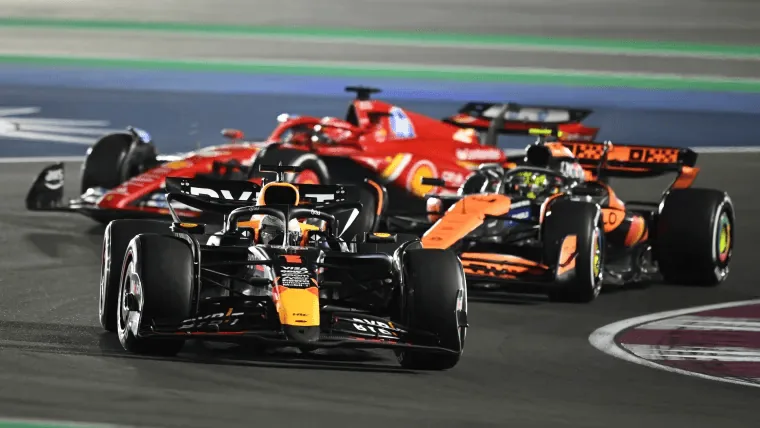
The 2025 season ended the way proper F1 seasons should: with real pressure, real trade-offs, and a championship decided on Sunday night in Abu Dhabi. Max Verstappen won the final race; Lando Norris finished P3, and that was enough to take the Drivers’ title by 2 points. Final scoreline: Norris 423, Verstappen 421, Piastri 410. In the constructors’ battle, McLaren closed it out emphatically: McLaren 833, Mercedes 469, Red Bull 451, Ferrari 398.
That’s the “what.” The “why” is where 2025 got interesting, because Red Bull’s year was defined by a car that was fast but picky, while McLaren’s year was defined by having arguably the best overall package… and repeatedly finding ways to throw points away.
Red Bull’s RB21: A Car With a Knife-Edge Setup Window (and a Late-Season charge)
If you want the one liner for Verstappen’s first half: performance seemed to exist, but it was locked behind a “super narrow” operating window. Verstappen himself described how easy it was to be “out of the window,” and that when it’s right, the car looks “quite okay”—which is basically code for “Friday is pain, Saturday is triage, Sunday depends on what we learned.”
That’s exactly the pattern we saw: Red Bull frequently seemed to be nowhere on Fridays, then “found it” through setup work and kept Verstappen alive in the fight. Later in the year Verstappen also acknowledged they’d been going “left and right with the setup” and only gradually got to something more stable.
By mid-season, much of the grid had already shifted focus toward 2026. Red Bull deliberately did not. The team made it clear that continuing RB21 development was not about chasing short-term performance alone, but about understanding the car’s underlying weaknesses. Red Bull openly acknowledged that the RB21’s narrow operating window was a conceptual issue they had to solve, specifically to avoid carrying those characteristics into the 2026 car. In that context, development on the 2025 platform was viewed as risk reduction rather than distraction: if they could stabilise the RB21, they could close the season competitively and enter the next regulation cycle with a cleaner baseline instead of unresolved problems.
Outcome: Verstappen didn’t just stay in it he dragged it to a title decider and missed the title by two points.
McLaren: Championship-Winning Pace… and Self-Inflicted Wounds
McLaren secured both titles, but remnants of their midfield era were still visible throughout 2025. While the car was consistently good enough to fight at the front, the team often operated with a degree of caution and self-doubt that no longer matched their true competitive position.
1) Strategy
The cleanest example is the Qatar GP safety car call. With the race neutralised, McLaren refused to pit, seemingly paralysed by the optics of “favouring” one driver, while Verstappen (and the whole rest of the grid) did pit and flipped the race. Motorsport.com’s preview of the finale states it bluntly: McLaren’s indecision around not wanting to favour a driver contributed to them losing out. (motorsport.com) RaceFans’ analysis frames it as misreading the “free stop” economics and paying a huge price. (RaceFans) Even McLaren’s own post-mortem messaging (via reporting) is essentially: yes, this one mattered. (ESPN.com)
If you want a single datapoint for “Papaya rules = points leakage,” Qatar is the one you circle in red marker.
2) Pit stops: Not Just “One Bad Weekend” A Pattern (Especially for Norris)
McLaren’s pit work was not consistently terrible, but it had high-variance failures at the worst possible moments. For example Norris being hit by slower stops in three consecutive races, including a 4.83s stop at Zandvoort, then another slow stop at Monza, then another 4+ second stop in Baku all during peak title pressure.
3) Consistency and “Papaya Rules”:
McLaren’s “Papaya rules” concept (keep it clean, keep it fair, avoid any teammate conflict) is noble. The problem is that it can turn into decision paralysis, and F1 punishes hesitation more reliably than it punishes aggression.
Prime example: the Monza mess. The Slow stop undercut/position swap drama, became a public example of McLaren trying to “manage fairness” after an operational error, instead of just letting the race be the race.
My take: “Papaya rules” are a feel-good marketing layer on top of a brutally competitive sport. You can’t run a championship campaign like HR is in the room. The best teams have a clear priority: maximise titles first, explain it second. When you try to explain it first, you end up doing things like Qatar.
The Numbers That Ultimately Matter
Final Drivers’ Championship (Top 10) (Formula 1® - The Official F1® Website)
- Norris - 423
- Verstappen - 421
- Piastri - 410
- Russell - 319
- Leclerc - 242
- Hamilton - 156
- Antonelli - 150
- Albon - 73
- Sainz - 64
- Alonso - 56
Final Constructors’ Championship (Top 5) (RaceFans)
- McLaren - 833
- Mercedes - 469
- Red Bull - 451
- Ferrari - 398
- Williams - 137
My Post-Season Driver Ranking (Top 10, Not Points-Based)
This is not “who scored most points” (that list is above). This is who i think maximised what they had, factoring in car traits, execution under pressure, and how many points they left on the table.
- Max Verstappen - Dragged a knife-edge RB21 into a title-deciding final round with relentless execution.
- Lando Norris - Champion, absorbed pressure in a 3-way finale and didn’t crack when it got chaotic.
- George Russell - Clean, consistent, and quietly the best “systems driver” of 2025; carried Mercedes to P2 in constructors.
- Oscar Piastri - Title contender until the end; quick enough to win anywhere, but left just enough points behind through critical swings (some team-made).
- Charles Leclerc - Strong peaks, but Ferrari’s overall season (and execution layer) didn’t convert often enough.
- Carlos Sainz - Solid points conversion and a great second half of the season.
- Lewis Hamilton - I can only hope his role in Ferrari’s rebuild year was broader than Sundays.
- Kimi Antonelli - 150 points as a rookie in a modern F1 field is a real output.
- Alex Albon - 73 points in that Williams is maximum extraction.
- Fernando Alonso - Still one of the best at turning weird races into points.