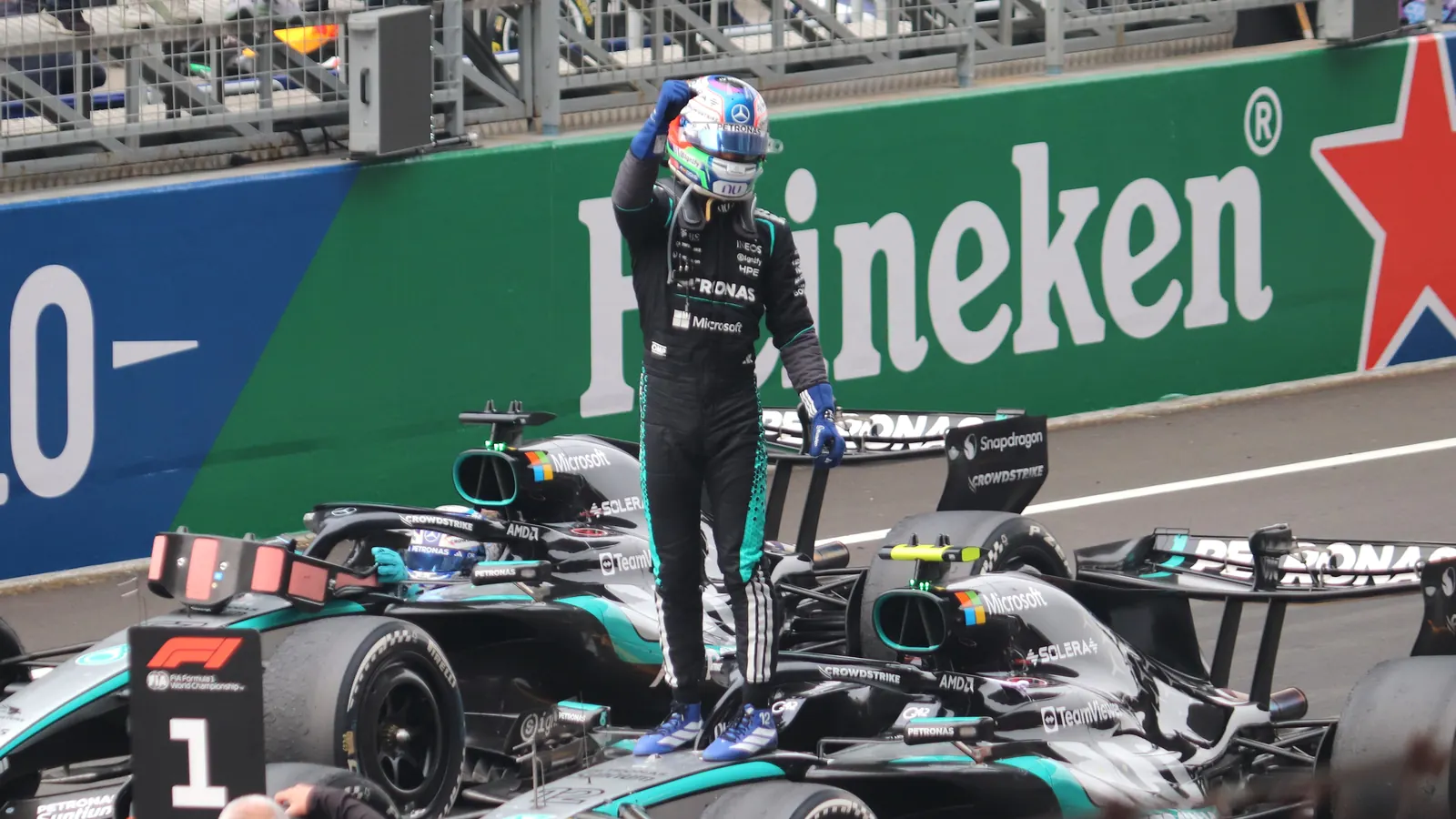
Kimi Antonelli is the 2026 Formula 1 World Champion. He needed a ninth place in Mexico City, finished third, and became the youngest champion in F1 history at 20 years old. It's Mercedes' first drivers' title since Hamilton in 2020 and the first for an Italian since Alberto Ascari in 1953. He's won nine Grands Prix this year and sealed it with four races to spare. (Formula 1, ESPN)
But look at who won the race: Max Verstappen, from fifth on the grid, in a Red Bull with Red Bull's own engine. That's his third win of the season, and I think it tells you more about 2027 than the trophy does about 2026.
So this post is two stories. How Mercedes won the new regulations, and why Red Bull's comeback makes next year the one to watch.
The Mercedes Head Start: Not One Trick, But Everything At Once
Every big rule change rewards whoever arrives at the first race having understood the rules best. In 2014 that was Mercedes. In 2022 it was Red Bull. In 2026 it was Mercedes again, and the margin early in the year was huge.
Mercedes took the first 10 pole positions of the season. (The Race) In one early qualifying session, Russell's pole was 0.785s faster than the best non-Mercedes car (Hadjar's Red Bull) and 0.862s faster than Piastri's McLaren. (The Race)
That McLaren gap is the interesting part. The McLaren runs the same Mercedes engine, and the rules say works and customer teams must get identical hardware and modes. So the advantage wasn't the engine alone. Three things came together:
1) Energy deployment
The 2026 power units get roughly half their power from the electric side, so when and where you deploy battery energy is now a huge part of lap time. The Race's analysis of that qualifying session found that one ~25-second stretch of the lap, about 32% of the distance, accounted for 73 to 92% of the rivals' total time loss to Russell. That's all deployment. Piastri summed it up: "in some corners we've got effectively 450 horsepower less."
McLaren boss Andrea Stella was even clearer: "This doesn't have to do with the hardware, this has more to do with learning about the hardware." (The Race)
2) The engine itself
The deployment advantage was software and know-how, but the hardware was also strong. Mercedes was widely seen as having the best power unit early on, partly through clever use of the compression-ratio rules. That was clever enough that the FIA brought forward a change to how compression ratio is measured (hot and cold from 1 June, hot only from 2027). (GPblog, RaceFans)
And don't forget Mercedes has been building hybrid systems since 2009. (Motorsport Week) Seventeen years of hybrid know-how doesn't show up in a spec sheet, but it shows up on track.
3) A genuinely good car
Stella also said Mercedes was "overall faster in the grip-limited sections." Russell: "we've also got a really amazing car beneath us." (The Race) After four years of Mercedes never really understanding ground effect, they got the new aero concept right from day one.
My take: this is what a real head start looks like. A great engine is not enough. You need the engine, the energy software and the chassis all designed together, and running properly from the first race. Mercedes was the only team that turned up with all three, and that early-season run is what Antonelli built his title on.
Red Bull: From "First Engine, Messy Car" to the Team to Beat
Now the other side. Red Bull started 2026 with a huge task: its first in-house power unit, built by Red Bull Powertrains with Ford, on top of a completely new car. And it showed.
The early RB22 had through-corner balance problems, and both drivers complained about handling and engine reliability. (Crash.net) Red Bull Powertrains tech director Ben Hodgkinson has since admitted that work on the combustion system ran longer than planned, which left too little time to optimise the engine before the opening races. (Grande Prêmio)
Then the turnaround came, and it came from two directions.
The Baku package
Red Bull brought what it called its final major upgrade of 2026 to Baku: a new floor and diffuser, new sidepods, cooling louvres, mirrors and halo fairing. (Formula 1) Laurent Mekies said in the same breath that the focus was already shifting to 2027. (Crash.net)
Calibration, not new hardware
The engine got better without new homologated parts. Hodgkinson credits better calibration and energy management, meaning the combustion engine, energy recovery and deployment working together better. The design "still contained performance potential that had not been fully exploited." (Grande Prêmio) That's the same kind of know-how gain that gave Mercedes its early edge. Red Bull just started later.
The results
- The Bahrain Grand Prix at Sepang: Verstappen's first win of 2026, and the first pole and win ever for a Red Bull Powertrains engine.
- Singapore: sprint and Grand Prix.
- Mexico City: won from fifth on the grid, holding off Hamilton.
George Russell has called Red Bull the team to beat. Even Toto Wolff, talking about Red Bull's engine: "You can't see that it's lagging." (The Race)
Meanwhile Mercedes went the other way. Its second big upgrade was supposed to find three tenths and instead went backwards. Wolff says the car now needs a "very different set-up philosophy" with a narrower balance window. After 10 poles from the first 10 races, Mercedes took just one in the following seven. (The Race)
A narrow operating window that swings between understeer and oversteer. If you read my 2025 recap, that sounds very familiar. That was the RB21's problem last year. The roles have swapped.
Why 2027 Is Going to Be Really Interesting
This is the part I'm most excited about. Three things point the same way.
1) The FIA thinks Red Bull has the best combustion engine
Under the ADUO catch-up system, the FIA compares engine performance and gives extra development to anyone who's too far behind. The result surprised everyone: Red Bull was ranked the best internal combustion engine, Mercedes about 2% behind, and everyone else more than 4% behind. (The Race, GPFans)
The downside for Red Bull is that it's now the only manufacturer without extra upgrades. Mercedes gets one extra in 2026 and one in 2027; Ferrari, Honda and Audi get two in each year. Red Bull disputes the numbers and wants the system tweaked for 2027. (Yahoo Sports)
2) The 2027 rules shift power back to the combustion engine
Partly because of the "yo-yo racing" and the big speed differences between cars on full and empty batteries, the engine rules change for 2027 (Motor Sport Magazine):
| 2026 | 2027 | |
|---|---|---|
| Combustion / electric split | ~53 / 47 | 58 / 42 |
| Max combustion engine output | 400 kW | 420 kW |
| Max electrical deployment | 350 kW | 300 kW |
| Energy harvesting | 350 kW | 375 kW |
| Fuel flow | baseline | +5% |
| Race distance | 305 km | 290 km |
Less electric, more combustion. If the team with the strongest combustion engine is Red Bull, these rules play straight into Red Bull's hands. Mercedes' big strength this year, getting the most out of the battery, matters a bit less.
3) Mercedes' development direction is an open question
Wolff himself said the recent races were "crucial for the development direction for next year." (The Race) If the latest upgrade path turns out to be a dead end, Mercedes starts 2027 with a chassis problem, while Red Bull switched its focus to 2027 straight after Baku.
The caveats
- Red Bull's battery side is still weaker than Mercedes'. 42% electric is less than 47%, but it's still a lot.
- Red Bull can't upgrade its engine under ADUO while Ferrari gets two upgrades, and Ferrari is already second in the constructors' with Hamilton on the podium in Mexico.
- Mercedes still has the champion, the strongest overall package across the season, and 630 points in the constructors'.
But a year ago Red Bull had a car that only worked in a tiny window and a brand-new engine program everyone expected to struggle. Now it has the benchmark combustion engine, three wins in the last few months and Verstappen at his best. I'd much rather start 2027 from where Red Bull is than from where Mercedes is.
Where We Stand With Four Races To Go
Official standings after Mexico, 19 of 23 races, with the post-race penalties for Piastri, Gasly and Colapinto applied. None of them changed the top of the table. (Formula 1 drivers, Formula 1 teams)
Drivers' Championship (Top 6)
- Antonelli - 380 (champion)
- Verstappen - 261
- Hamilton - 259
- Russell - 250
- Leclerc - 245
- Norris - 221
Constructors' Championship (Top 4)
- Mercedes - 630
- Ferrari - 504
- Red Bull - 382
- McLaren - 365
Mercedes can wrap up the constructors' in Brazil. The fight for second in the drivers' (Verstappen, Hamilton, Russell and Leclerc, all within 16 points) is the best fight left this season. I'll do a full season recap and driver ranking after Abu Dhabi.
Congratulations Kimi, well deserved. Enjoy it, because 2027 is going to be a lot harder.
Cover photo: Kimi Antonelli after the 2026 Chinese Grand Prix by Liauzh, CC BY 4.0, via Wikimedia Commons. Cropped and resized.